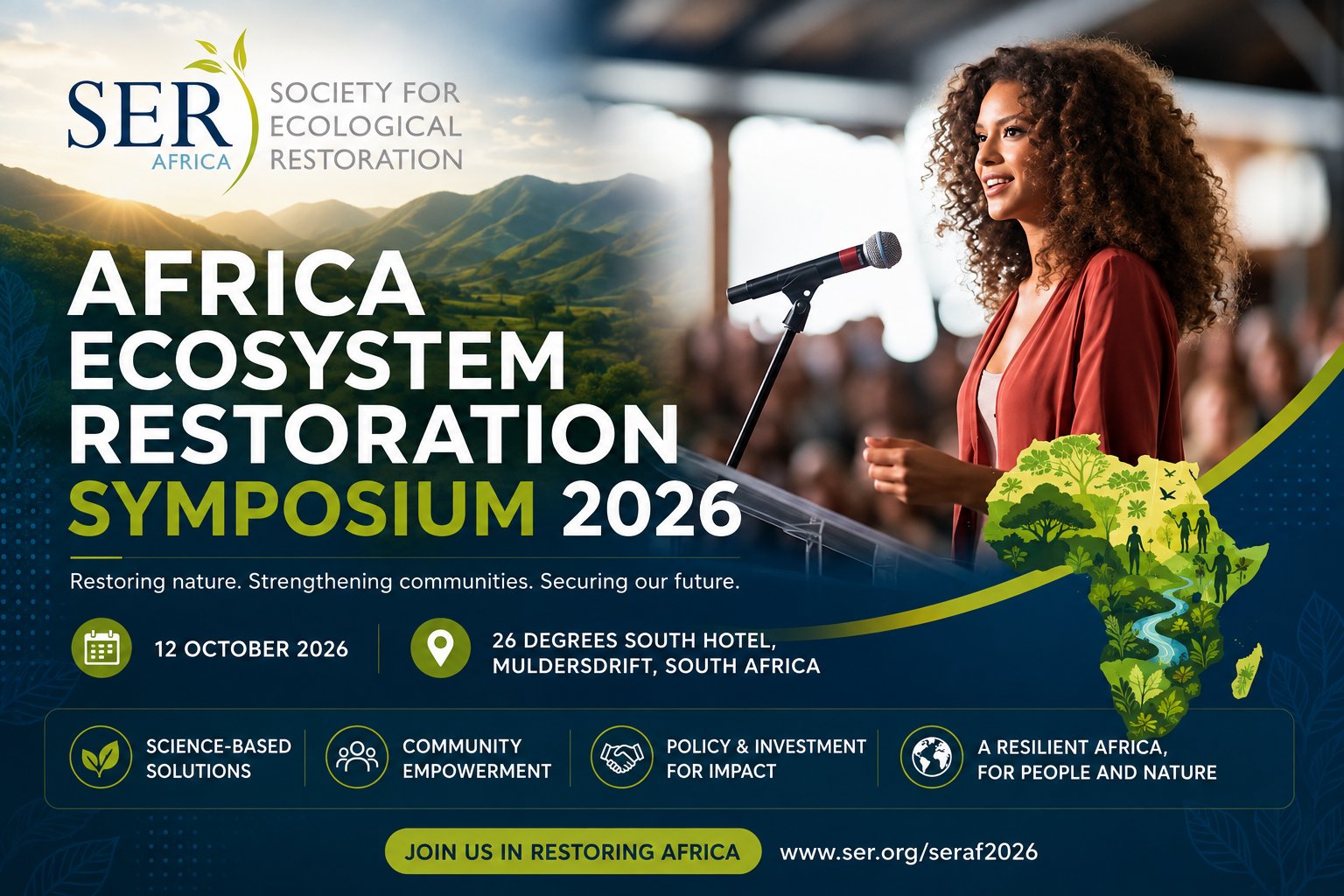
ConferenceAfrica Ecosystem Restoration Symposium 2026
Africa is entering a decisive decade for ecosystem restoration. With more than 700 million hectares already degraded and climate-related risks intensifying across landscapes, restoration is no longer a peripheral scientific concern—it is central to securing water, sustaining biodiversity, reducing disaster risk, and supporting livelihoods across the continent. The urgency is no longer about understanding degradation, but about implementing restoration at scale in ways that are scientifically grounded, socially inclusive, and institutionally embedded. The Society for Ecological Restoration Africa Chapter (SER-AF), established in 2021, continues to play a central role in advancing restoration science, practice, and policy across the continent. Through its growing network of researchers, practitioners, and policymakers, SER-AF has contributed to strengthening collaboration and knowledge exchange in ecological restoration. Building on this momentum, the Africa Ecosystem Restoration Symposium 2026 is convened as a continental platform to move beyond dialogue and towards coordinated implementation. The Africa Ecosystem Restoration Symposium 2026 aims to strengthen the science–practice–policy interface and support the implementation of ecosystem restoration at scale across Africa. The Symposium seeks to: o Facilitate the exchange of cutting-edge research and practical restoration approaches o Strengthening collaboration among researchers, practitioners, policymakers, and funders o Showcase scalable restoration solutions across diverse African landscapes o Advance the mainstreaming of ecological infrastructure and ecosystem-based disaster risk reduction (Eco-DRR) o Support the development of actionable pathways for restoration implementation The Symposium is positioned not merely as a scientific gathering, but as a platform for coordination, learning, and alignment across sectors and scales. A defining feature of the 2026 Symposium is the integration of the 5th Catchment-Based Indaba (CBI) as a parallel platform within the programme. The Catchment-Based Indaba focuses on strengthening climate resilience through integrated catchment management, with a particular emphasis on mainstreaming ecological infrastructure and Eco-DRR into local development planning and governance systems. The inclusion of the CBI strengthens the Symposium by anchoring discussions in real-world implementation challenges, particularly in relation to water security, land degradation, and climate adaptation. It provides a dedicated platform for engaging practitioners, government stakeholders, and communities, ensuring that the Symposium moves beyond knowledge exchange to address institutional and operational realities. The structure of the Symposium is as follows: o Day 1 (12 October): Arrival, registration, and high-level opening ceremony o Day 2 (13 October): Field-based learning through site visits and facilitated reflection sessions o Day 3–4 (14–15 October): Plenary and parallel sessions, including technical presentations, practitioner dialogues, and thematic discussions o Day 5 (16 October): Departure